
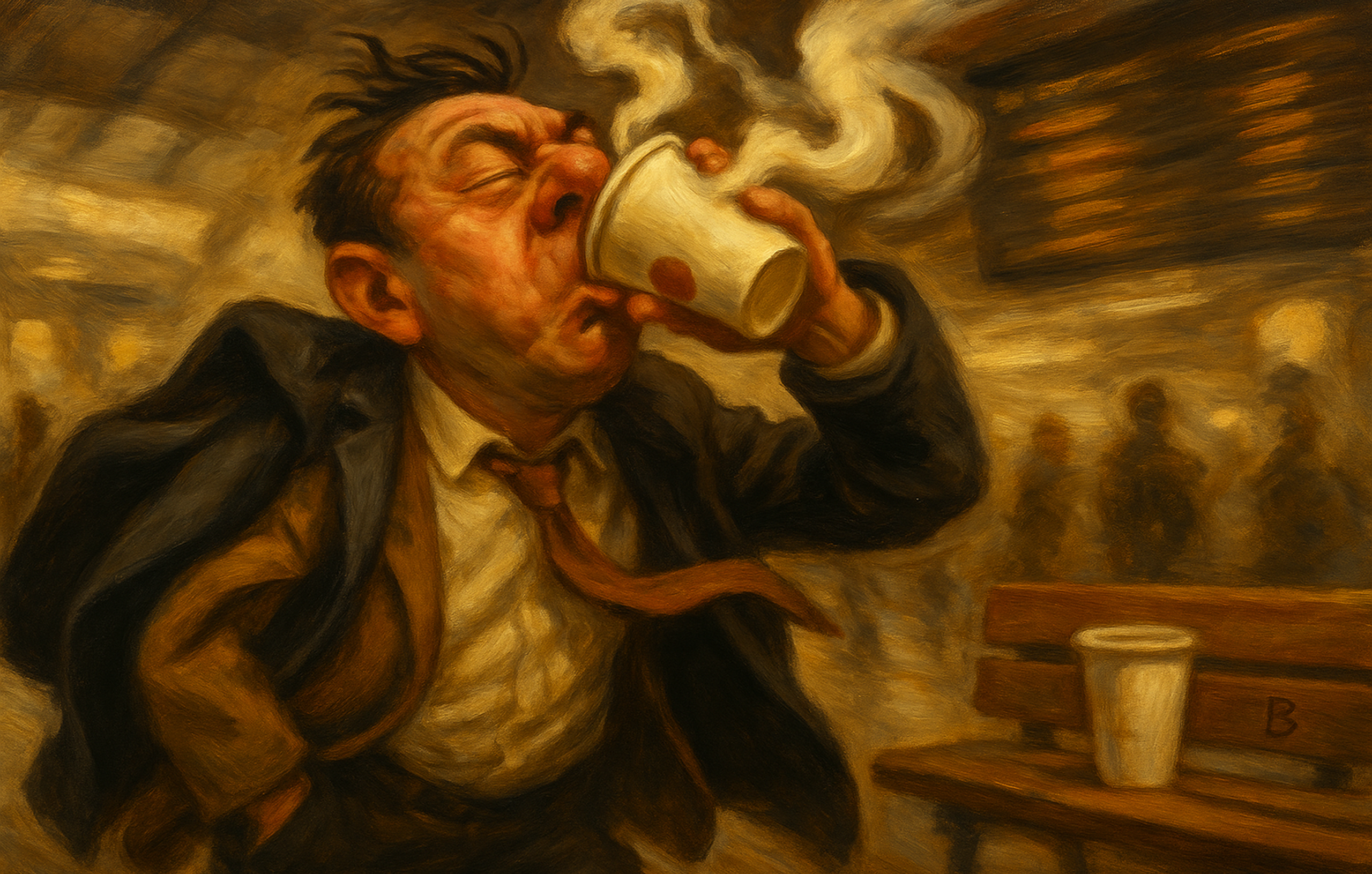
The headline said coffee. The study said temperature. Those are not the same sentence, and the gap between them is where every bad decision of the next fortnight is going to live.
Researchers at Oxford looked at close to 980,000 middle-aged adults in the United Kingdom, drawn from the Million Women Study and UK Biobank, and followed them for well over a decade. People who liked their tea and coffee hot carried close to twice the risk of oesophageal squamous cell carcinoma compared with people who liked them warm. People who liked them very hot carried more than three times the risk. Milk made no difference. The drink made no difference. The heat did.
The researchers estimate that around fourteen percent of new cases of this cancer in the United Kingdom could be avoided if people simply let the cup sit. Not quit. Sit.
Read that back and notice what is actually being described. The hazard is not a substance. The hazard is a behaviour, and the behaviour is impatience. Nobody drinks a beverage at scalding temperature because they prefer the sensation of being burned. They drink it that way because they are leaving, because the meeting starts in four minutes, because the cup arrived and the day has already moved on without them. The risk factor here is the calendar.
Which is why this one belongs on the business pages rather than the health pages.
A cafe understands this instinctively even if it has never articulated it. The drink comes out at around ninety-two degrees and is genuinely at its best somewhere in the sixties. Every serious operator knows there is a window, and every serious operator watches a queue of people miss it daily. The house is not selling a liquid. It is selling a pause, and about half the customers decline the pause and take only the liquid, then wonder why it tasted of nothing but heat.
The wider lesson generalises hard. Most of the things that damage an organisation are not the ingredients. They are the speed at which the ingredients are consumed. The funding round was not the problem, the deployment schedule was. The hire was not the problem, the two-week onboarding was. The acquisition was not the problem, the eleven-month integration crammed into four was. In every case an inquiry will be launched into the coffee when the finding was always about the temperature.
There is a second thing worth holding onto. The absolute risk here stays low. Oesophageal cancer accounts for around two percent of cancer cases in the United Kingdom, and smoking remains the dominant risk factor by a distance. The study is not an instruction to panic, and the researchers did not frame it as one. It is a precise finding about a specific and entirely free intervention: wait.
That is the part that makes it useful rather than merely alarming. Most risk reduction costs money, or willpower, or the surrender of something enjoyable. This one costs four minutes and asks you to give up nothing at all. You still get the coffee. You get a better version of the coffee. The only thing on the table is the hurry.
Which is, of course, exactly why it will be ignored.
We will accept a supplement, a regime, a device, a subscription, a protocol with a name. We will pay for almost any intervention that can be purchased and performed. What we will not do is stand still next to something we have already bought and wait for it to become good.
The cup was never in a rush. You were.
Source: CNN, “Drinking very hot beverages could triple cancer risk, large study finds”
