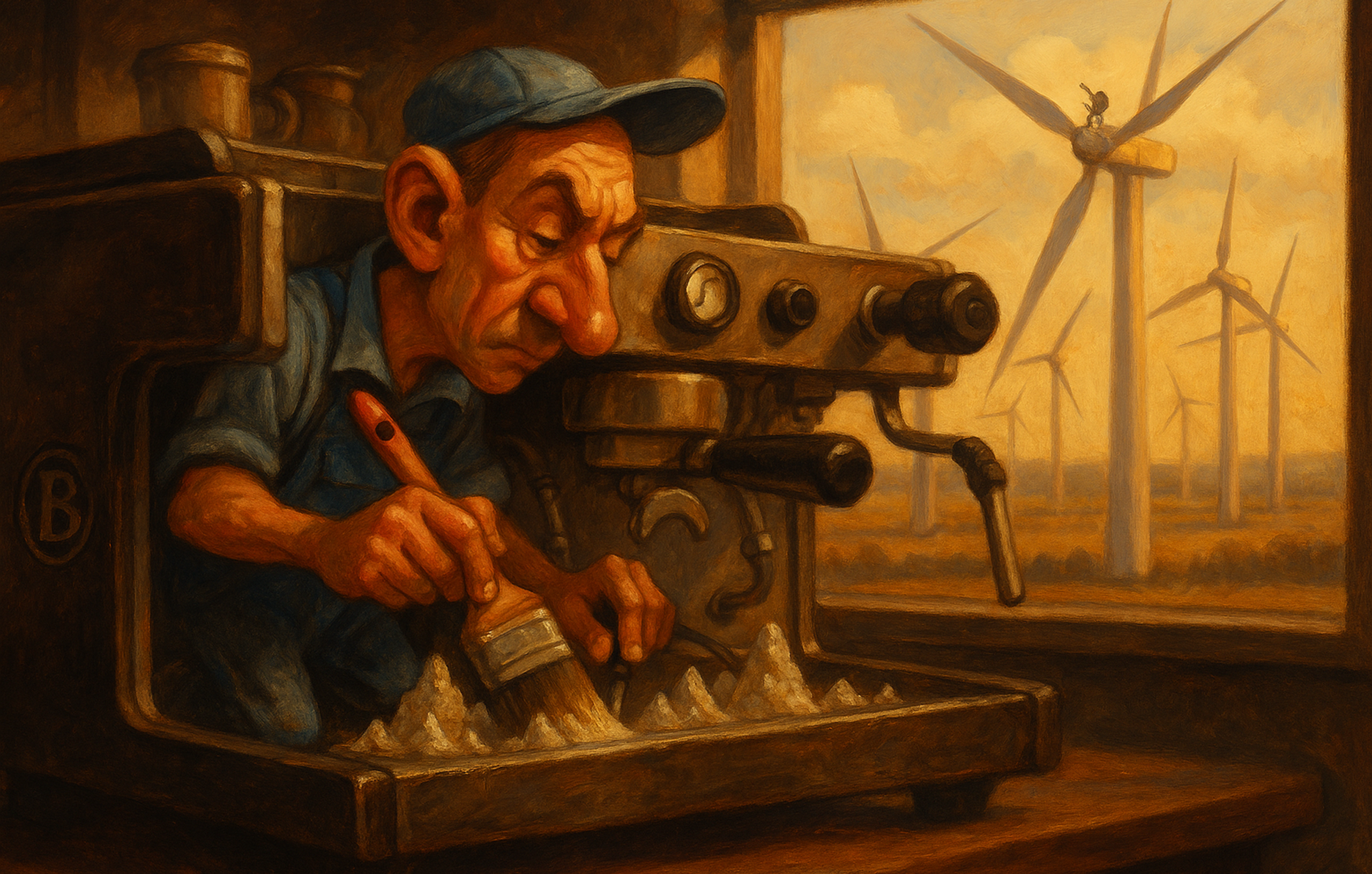
Everybody wants to sell the espresso machine. Almost nobody wants to descale it. Guess which one has the recurring revenue.
The current read on wind power investment makes the point with unusual clarity. The interesting startups are no longer the ones proposing to build turbines. They are the ones proposing to look after the turbines that are already standing: inspection robotics, predictive maintenance software, blade monitoring, grid optimisation, repowering, blade recycling. Aerones raised 62 million dollars in 2025 to scale robotic turbine maintenance. More than 320 energy startups took first funding that year. Meanwhile onshore wind’s global weighted-average cost of energy sat around 33 dollars per megawatt hour, which is to say the hard part is no longer generating the electricity cheaply. The hard part is keeping the thing that generates it from breaking.
The numbers underneath are the whole argument. Operations and maintenance can absorb a fifth to a quarter of a wind farm’s lifetime spend. A single turbine failure runs somewhere around 100,000 to 150,000 dollars to repair, with another 50,000 to 75,000 in electricity that never got sold while the blades stood still. Offshore, a technician needs a boat and a weather window before they need a spanner.
Which brings us back to the counter. A cafe owner buying their first machine spends weeks on the purchase. Which grouphead, which grinder, which finish. Then the machine arrives and the actual business begins, and the actual business turns out to be water hardness, filter changes, gasket wear, and the quiet Tuesday when the pump goes and you serve nothing for a day and a half. The purchase was an event. The upkeep is the company.
The lesson for anyone deciding what to build is not that unglamorous work pays better. It is more specific than that. The biggest installed base in any industry is the most reliable customer that industry will ever have, because it already exists, it is already spending, and it has no choice about spending. Building the next turbine requires someone to believe in your future. Servicing the ninety thousand turbines already turning requires only that they keep turning, which they will, whether or not anyone believes in you.
That is a fundamentally different risk profile, and it is the one available to a founder without a decade of capital behind them. Floating offshore platforms are a genuinely large prize and they demand enormous money, long timelines and technology that has to work in open water. Inspection software demands a laptop, a fleet operator willing to run a pilot, and evidence that you caught something before it failed. One of those is a venture bet. The other is a business you can start on a Tuesday.
There is a catch, and it is worth naming rather than glossing. Maintenance markets are crowded, buyers are conservative utilities who move slowly and dislike sending operational data anywhere, and hundreds of vendors are already saying the same sentence about the same sensors. Nobody wins that on the pitch. They win it on the boring proof: this asset, this failure, this many weeks of warning, this much avoided cost.
So the shortcut, if there is one, is to stop looking at what an industry is excited about and start looking at what it already owns.
Everyone is watching the new machine come through the door.
The money has been in the limescale the whole time.
