Nobody ever taught you to point. And yet, if you run a coffee account, there is a decent chance you have ended your biography with a small downward arrow, aiming a stranger’s eye at a link sitting seven pixels below. No manual told you to. No platform update announced it. There was no onboarding screen, no best-practices email, no cheerful tooltip suggesting it. You just started doing it, the way everyone around you started doing it, and now it looks less like a choice than like grammar – a rule you obey without ever having read.
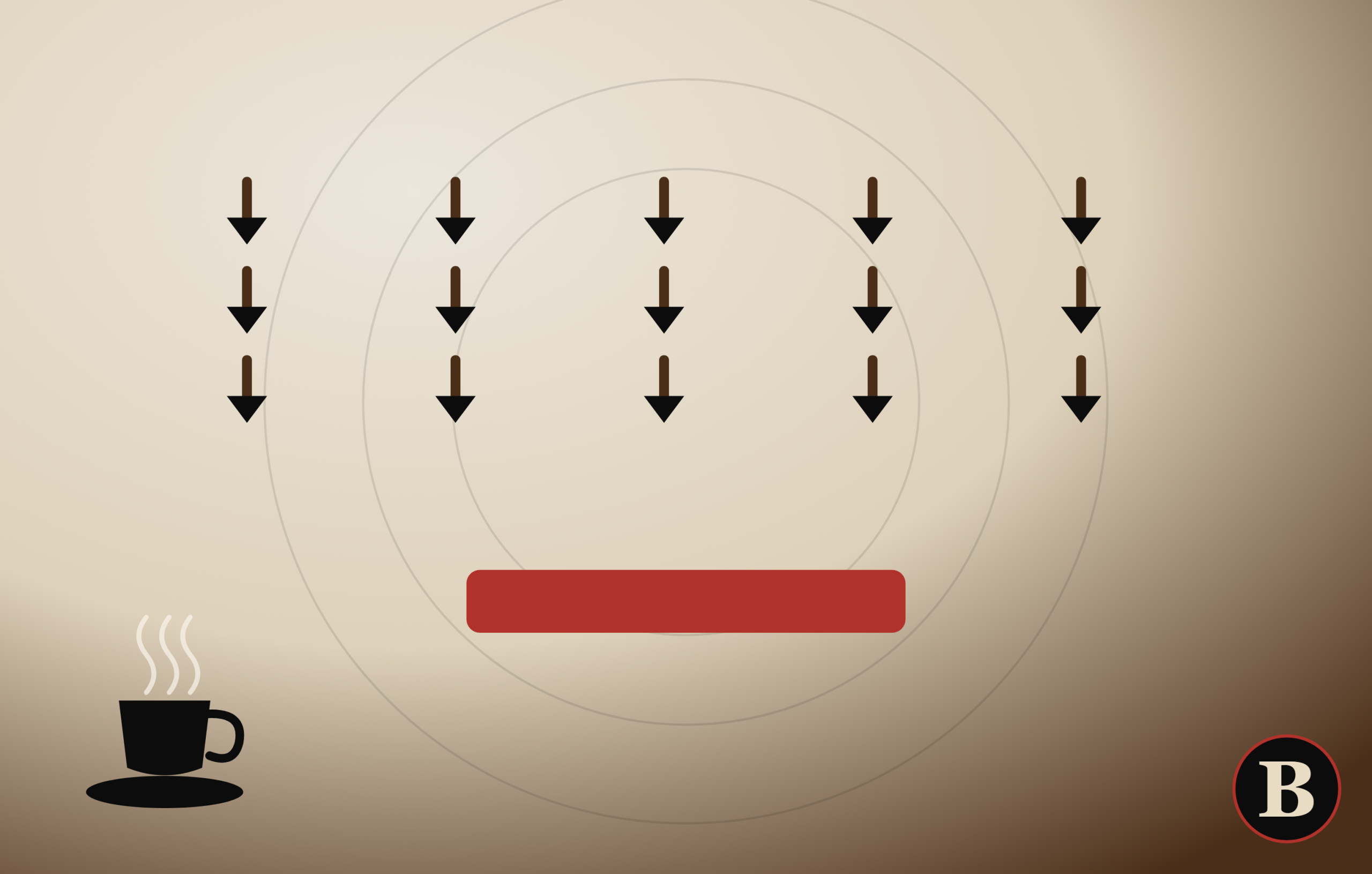
BeanBreaker Intelligence went looking for the most repeated instruction in coffee’s corner of Instagram, and this is what it found. In How The World Talks About Coffee, August 2026, across 2,164 coffee-associated accounts, 249 biographies end with a downward arrow or a pointing finger, placed there for one job: to draw the eye to the single link beneath it. The tally splits into a down-pointing finger 111 times and a downwards arrow 77 more, plus their cousins. There is no documentation for this. No agreement was signed, no standard published, no committee convened to ratify the gesture. It simply arrived, fully formed, in a couple of hundred bios that never met each other – the most repeated instruction in the entire corpus, and one that no single person can claim to have written.
This is what a good espresso bar does without a sign on the wall. You do not need a diagram to know the queue moves left, that you order before you hover, that the person calling out drinks is not to be interrupted mid-pour, that the milk station is a place you visit and leave rather than colonise. The choreography teaches itself through repetition until it feels like physics rather than custom. Nobody instructs you; the room does. You watch one person, then another, then you find your own body already doing it before your mind has caught up. The arrow in the bio is that same room, except the room is a platform, and the lesson is delivered so quietly that everyone mistakes the habit for their own idea.
What makes the arrow such a clean specimen is that it is useless anywhere else. It carries no meaning on a page, no function in an email, no life outside the exact inch of screen it was bred for. It is grammar without a language, a word that means nothing except “look immediately below me,” and it means that only here, only in this one context, only because the platform built a context where such a word became necessary. Coffee did not invent it. Coffee simply caught it, the way a room full of people eventually catches a yawn, and passed it on.
Which is the part worth sitting with. We tend to imagine our online behaviour as a series of decisions we made – our aesthetic, our voice, our little flourishes, the personality we think we are broadcasting. But 249 people converging on the exact same gesture, unprompted, is not 249 decisions. It is one lesson, absorbed 249 times, from a teacher nobody can name. The platform never issued the instruction; it merely arranged the furniture – one link, placed just below the bio, easy to miss – so that pointing downward became the obvious solution to a problem the platform itself had created. Then it let imitation finish the job. That is a more powerful kind of authorship than any tutorial, because it never shows its hand. A rule you were taught you can question, argue with, refuse. A rule you absorbed feels like instinct, and instinct does not ask for a receipt.
So the real question is not why coffee people point. It is what else has been installed in you the same way – the caption cadence you fell into, the reflex to reply within the hour, the sense that a grid should look a certain way, the quiet conviction that a post before nine in the morning is somehow wasted. All of it learned from a curriculum nobody admits to writing, taught by a room that never speaks. The arrow is just the tell that slipped, the one habit visible enough to count. Two hundred and forty-nine hands, pointing in unison at a link none of them were taught to use, and every single one convinced it was their own good idea.
