Stefan Kalb has launched a company called Latch in Seattle, with an $8 million seed round led by FUSE and co-founder Jared Kofron, a University of Washington physics alum and former principal engineer at Pioneer Square Labs. It began life as Super Labs and rebranded this year. The stated mission is to liberate humanity from doing work that owns us, which is the kind of sentence that usually means nothing and in this case means something quite specific.
The product records an employee performing a task while they narrate it, the way you would train a new hire, then turns that into a knowledge graph of how the company’s processes actually run and serves it to the firm’s AI agents. Kalb’s own framing of the misunderstanding is the sharpest part of the pitch. People think it is Loom. A Loom is a video sitting in a folder waiting for a human to watch it. Here the video is the input, and what gets extracted from it is the product.
Kalb’s history is worth the paragraph. In 2009 he started Molly’s, a fresh food supply business serving Seattle cafes and hospitals. That led to Shelf Engine in 2016, which used machine learning to cut food waste for retailers including Target, Kroger and Walmart, scaled past ten thousand grocery locations and raised around $60 million before being acquired by the New York data company Crisp in 2025. Kalb has described that exit as disappointing, and has said he intends to scale this one more deliberately than the last, where fast hiring created its own problems.
So the man building a system to capture how work really gets done spent a decade inside grocery operations, which is the least abstract environment in commerce.
Now the cafe, because coffee is where this gap is most visible to the naked eye.
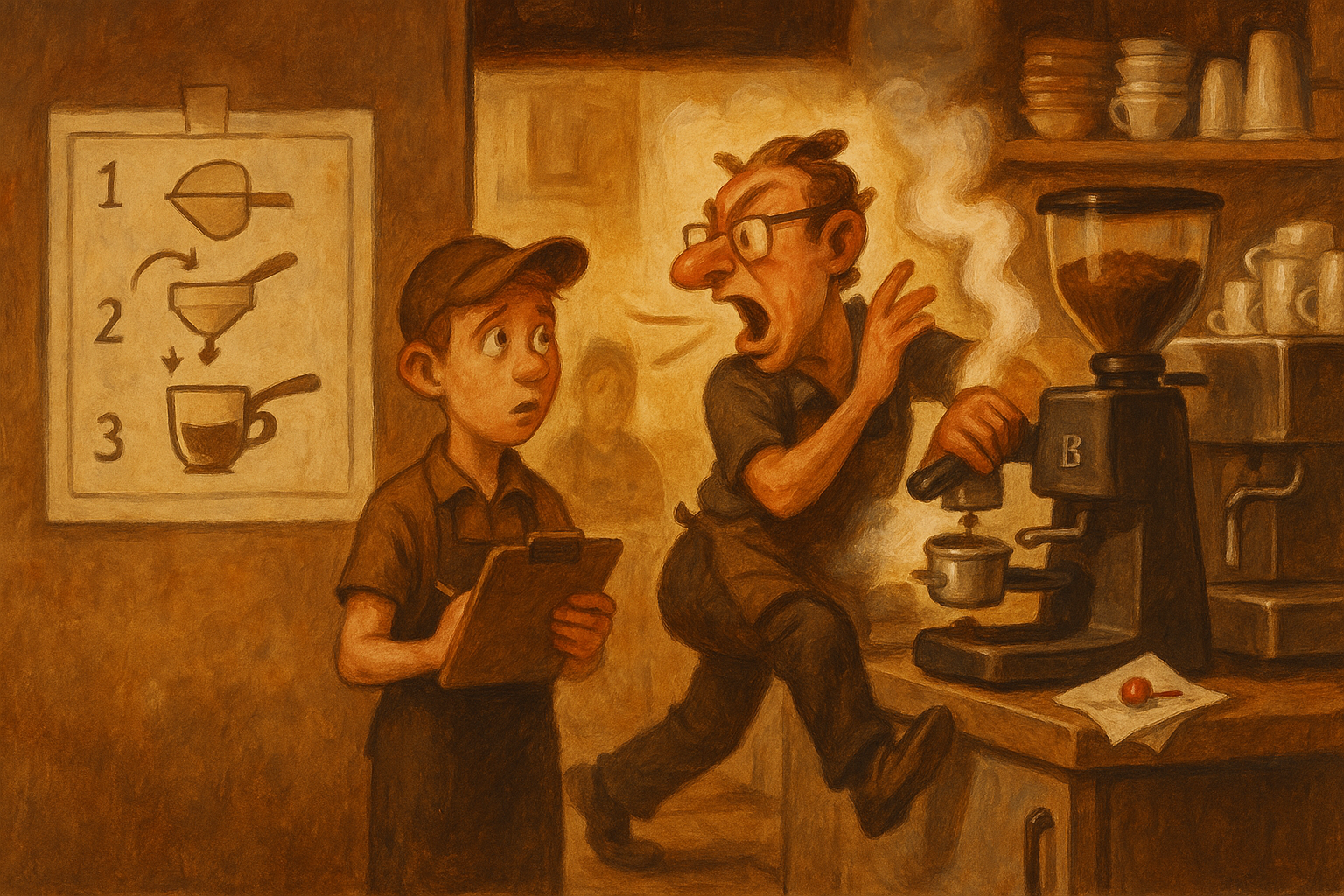
Every shop has a manual. The manual says eighteen grams in, thirty-six out, twenty-eight seconds, wipe down at close. Now watch an actual shift. The grinder drifts every ninety minutes in humid weather and the closer knows to check it at four. The second fridge door does not seal unless you lift as you push. The regular at the window table gets a smaller cup because he takes it to a meeting and the big one goes cold. The delivery driver comes to the side door because the front step is too high for the trolley. There is a napkin folded under the front right leg of the machine, and the napkin is load-bearing.
None of that is in the manual. All of it is the job. And it lives entirely in the heads of three people, one of whom is leaving in November.
That is the problem Latch is pointed at, and it has been the actual problem in enterprise software for forty years. Systems are built against the documented process. Value is produced by the undocumented one. The gap between them is where the business really operates, and every attempt to close it has failed the same way, because the only people who know the real process are too busy running it to write it down, and would not know what to write anyway. The knowledge is tacit. Asking someone to document their expertise gets you the manual again.
Recording the work instead of interviewing the worker is a genuinely different angle of attack on that, and whether the extraction holds up is the entire technical bet.
The commercial question underneath it is sharper still. If agents are going to do meaningful work inside companies, they need the napkin under the machine leg. Right now they are all being handed the laminated sheet on the wall and asked why the espresso tastes wrong.
The manual describes the shop. The napkin runs it.
