
Tell people what next year costs and watch how fast next year stops being next year.
The Inter-American Development Bank ran a randomised information experiment in Suriname, a small open economy where macroeconomic weather tends to arrive without a forecast. Researchers handed households expert projections on inflation and currency depreciation. At the outset, those households were underestimating both, and not by a rounding error. Given the numbers, they revised their expectations sharply upward.
Then the researchers waited two years and went back to look at what those households actually owned. The ones who had been shown the forecast held fewer tradable durable goods. Consumer electronics most of all.
Nobody instructed them to stop buying televisions. They were told what was coming, and they quietly rebuilt their lives around it.
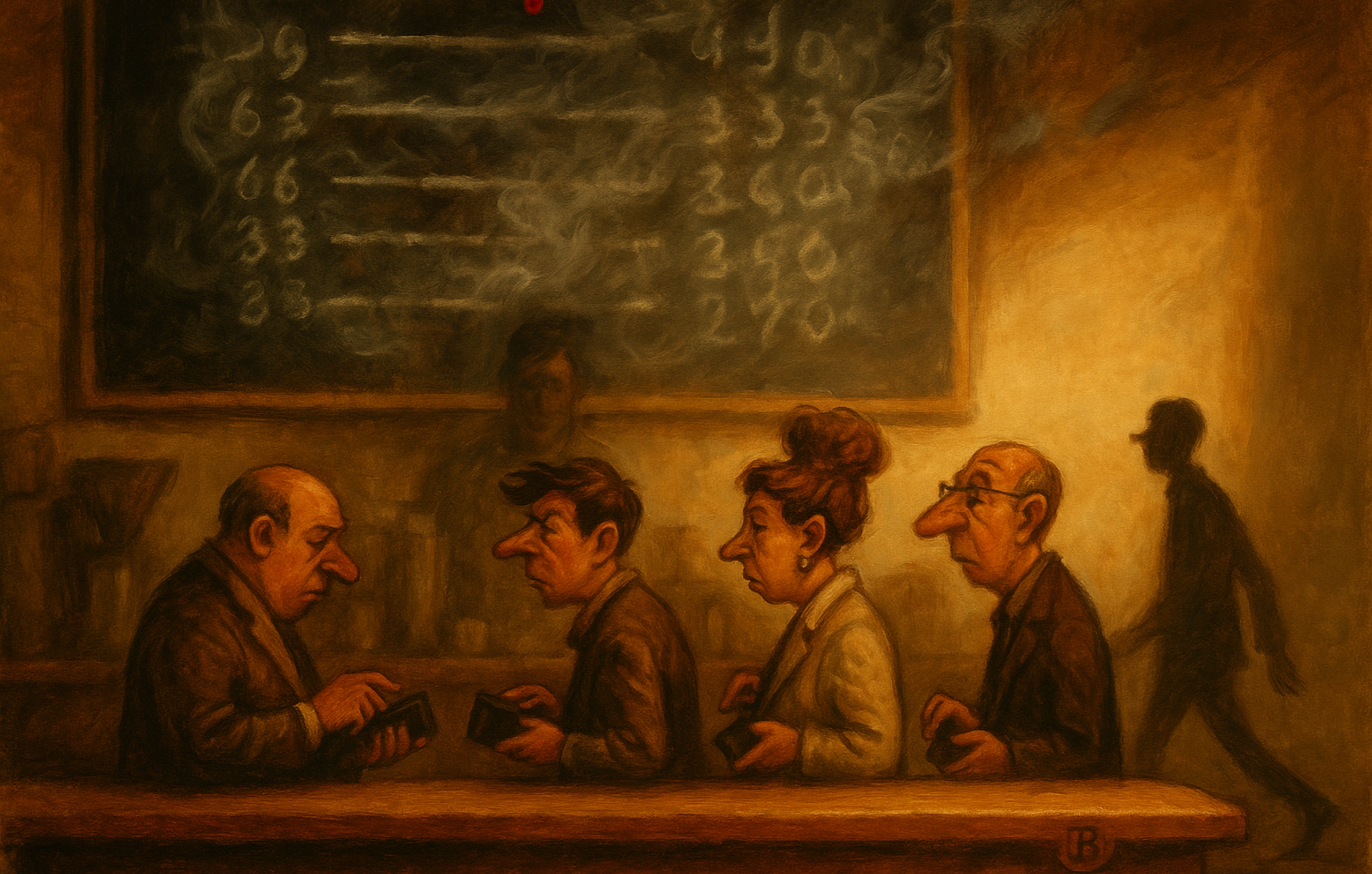
Every cafe has a board above the counter, and the board is doing more work than anyone credits it for. It is not a list of what things cost. It is an instruction about who you are going to be when you reach the front of the queue. You walked in wanting the flat white. You read the board. You order the filter, tell yourself you prefer it, and mean it by the time you sit down. The price never touched your wallet. It touched the decision, which is earlier and cheaper to move.
That is the finding underneath the study, and it is a more unsettling one than it first appears. A forecast is not a description of the future. It is an intervention in the present. The moment a number is published, it stops being a measurement and becomes an input, and the people who read it start behaving as though the thing has already happened. In Suriname it had not happened. Two years of purchasing behaviour bent around it anyway.
Which means the useful question about any forecast is not whether it turns out to be accurate. It is what the forecast does on the way to being tested. Central banks understand this instinctively, which is why they spend as much effort on how a rate decision is phrased as on the decision itself. The phrasing is the policy. The number is just the receipt.
There is a harder edge to it. The households in the experiment were not being manipulated; they were being informed, correctly, by people acting in good faith. The information was accurate and the response was rational. And still the outcome was that a group of people ended up with fewer things, because someone told them the truth about prices at a moment when they were free to act on it. Good information is not neutral. It reallocates.
For anyone who writes, advises, briefs, or forecasts for a living, that is the part worth sitting with. You are not describing the room. You are furnishing it. The projection you publish on Monday is somebody’s cancelled purchase on Tuesday and somebody else’s postponed hire in the spring. The accuracy of the projection is a separate matter entirely, and it arrives much later, usually after the behaviour has already settled.
The households did not misread the board. They read it perfectly, and that was the whole problem.
Nobody prices the menu expecting you to buy the menu. But that is the item that gets consumed first, every single time, and it is always free.
