
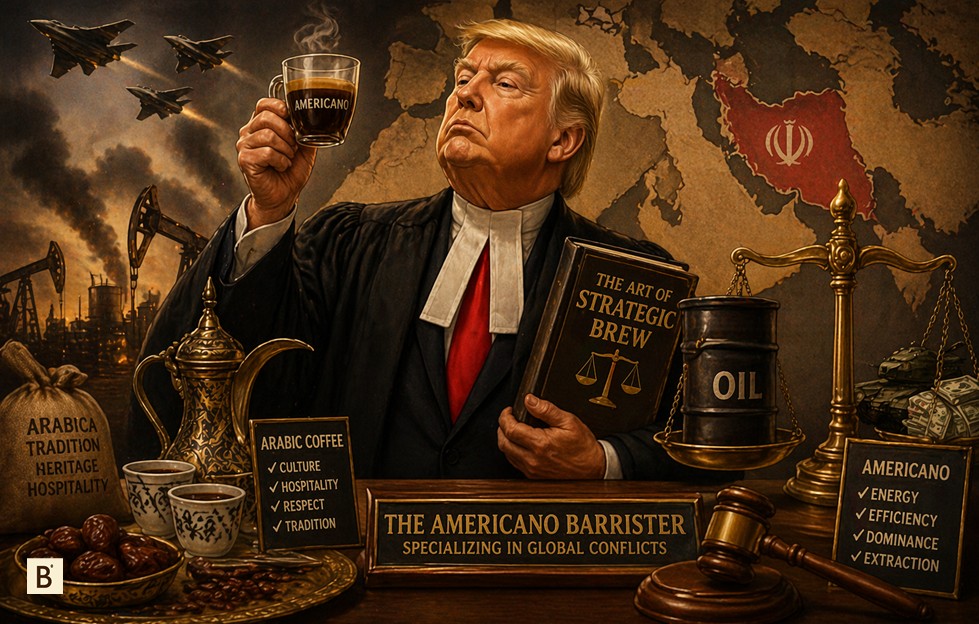
If modern conflict had a bar counter, it would not resemble chaos. It would be controlled, deliberate, and curated. The lighting would be precise. The movement would be intentional. The actors would not shout; they would position.
This is the nature of contemporary geopolitical engagement.
The assumption that war begins with visible escalation is outdated. In the current global system, conflict often begins with posture, signalling, and controlled narrative construction. The battlefield is only one layer. The more consequential movements occur before that – in how perception is shaped, how expectations are set, and how systems are prepared to respond.
In this environment, leadership is not only about command. It is about timing, sequencing, and presentation.
This is where the idea of the Americano Barrister becomes relevant.
The Americano Barrister as a Leadership Archetype
The Americano Barrister is not a soldier in the traditional sense. He does not rely on direct escalation as his primary instrument. Instead, he understands the power of controlled influence.
He enters moments of tension not to immediately ignite them, but to frame them.
In the case of heightened focus on Iran, shifting alliances, and renewed geopolitical positioning, the visible narrative centres on confrontation. However, beneath that narrative lies something more structured: a recalibration of global expectation.
This is where leadership becomes performative in a strategic sense.
The Americano Barrister does not need to dominate the room through force. He allows the room to reorganise itself around his signals. A statement, a pause, a recalibration of tone – these become instruments of influence.
In modern geopolitics, perception is not secondary to action. It is a precursor to it.
Arabic Coffee: Ritual, Presence, and Structural Meaning
To understand why this matters, one must first understand the environment in which this tension is unfolding.
In Arabic culture, coffee is not a beverage in the transactional sense. It is embedded within a broader system of social interaction. It represents presence, negotiation, acknowledgement, and respect. It is served within a context where relationships, not just outcomes, are being managed.
The act of serving coffee is structured. It follows a rhythm. It carries meaning beyond the cup itself.
This is not incidental. It reflects a broader cultural orientation toward interaction – one where timing, sequence, and presence matter.
When tension rises in such an environment, it disrupts more than political alignment. It disrupts systems of engagement that are deeply embedded in social and economic behaviour.
The Middle East is not simply a geopolitical zone. It is a structured environment where interaction has historically been governed by ritual, continuity, and negotiated presence.
The Americano System: Efficiency, Continuity, and Momentum
In contrast, the Americano represents a different system orientation.
It is built for continuity. It is scalable. It is efficient. It supports movement rather than pause. It is designed to operate within systems that prioritise output, consistency, and momentum.
This distinction is critical.
The Americano system does not rely on ritual to sustain itself. It relies on throughput. It functions within an environment where activity must continue regardless of conditions.
This extends beyond culture into economics.
The same system that produces the Americano also produces global financial markets, industrial supply chains, and large-scale capital allocation mechanisms. These systems are designed to absorb disruption and continue operating.
They do not pause for ceremony. They adjust and move forward.
Momentum Is Not Neutral
When tension rises in a region like the Middle East, the Americano system does not stand still.
It responds.
Oil markets begin to adjust immediately. Prices move not only on actual disruption but on anticipated risk. Contracts are renegotiated. Supply chain contingencies are activated. Financial instruments begin reflecting new expectations.
At the same time, industries aligned with security, defence, and energy begin to experience increased activity. This is not accidental. These industries are structurally positioned to respond to instability.
They are not necessarily the cause of tension, but they are designed to operate within it.
This is where the neutrality assumption breaks down.
Momentum in global systems is directional. It produces different outcomes for different actors.
Some contract under pressure. Others expand.
The Precision of Modern Tension
There is a recurring pattern in how global tensions develop.
They rarely escalate uncontrollably from the outset. Instead, they move within a controlled range.
High enough to trigger response.
Contained enough to avoid systemic collapse.
This creates a zone of sustained attention.
Within this zone:
- markets remain active,
- policy discussions intensify,
- resource allocation shifts,
- and strategic positioning accelerates.
This is not randomness. It is structural behaviour.
The global system has evolved to operate within these conditions. It does not require full-scale war to respond. It requires sustained tension.
Signalling Over Declaration
Within this framework, the role of leadership becomes more nuanced.
Direct declarations are no longer the only instrument of influence. In many cases, they are not even the primary one.
Signalling becomes more effective.
A calibrated statement can move markets.
A shift in tone can reposition alliances.
A visible pause can create uncertainty that triggers reaction.
The Americano Barrister operates within this space.
He does not need to articulate every move explicitly. He understands that the system will interpret signals and act accordingly.
This reduces the need for overt escalation while still producing real-world effects.
The Pattern Beneath the Headlines
For observers focused only on surface-level developments, the narrative remains simple: rising tension, potential conflict, geopolitical rivalry.
However, beneath that narrative lies a pattern that repeats.
When tension rises:
- certain industries contract,
- others expand,
- some nations adopt defensive positions,
- others move into strategic advantage.
This pattern is consistent across different moments and different regions.
It suggests that conflict, in its modern form, is not only reactive. It is integrated into how global systems operate.
Not in a conspiratorial sense, but in a structural one.
The system has adapted to tension as a condition of operation.
Systems That Continue Regardless
One of the defining characteristics of modern global systems is continuity.
They do not stop when tension rises. They reconfigure.
Markets continue to trade.
Industries continue to produce.
Governments continue to position.
This continuity is what gives the system resilience.
It is also what allows it to absorb and, in some cases, benefit from instability.
This does not negate the human or political cost of conflict. It highlights that, at a systemic level, operations persist.
The Role of the Americano Barrister Within the System
Within this environment, the Americano Barrister is not the sole driver of outcomes. He is an operator within a larger system.
His influence lies in:
- understanding how the system responds,
- positioning within that response,
- and shaping perception in ways that guide expectation.
He does not need to control every variable.
He needs to understand how variables interact.
That understanding allows him to operate effectively without overt force.
The Question Is Not Who Pours the Coffee
In a world that operates across different cultural and economic systems, metaphors help clarify underlying dynamics.
Arabic coffee represents structure, presence, and negotiated interaction.
The Americano represents continuity, efficiency, and system-driven momentum.
When these systems intersect under conditions of tension, the outcome is not determined solely by visible actors. It is shaped by the interaction of deeper structures.
This is why the question is not who is pouring the coffee.
It is who is controlling the conditions under which it is served.
Because in modern geopolitics, control is not always exercised through force.
It is exercised through temperature.


