The City Becomes the Counter
The store stopped waiting for you to come in and started reaching out through the city instead. Walmart is gearing up for a bold new delivery strategy in Los Angeles, with expansion into St Louis and Miami planned next, as The Economic Times reports. The question hanging over it is whether this becomes the new standard across the country. Strip away the logistics language and what is being redrawn is geography itself - the distance between the shelf and the doorstep, and who is expected to travel it.
Los Angeles is a telling place to start, and the choice is not accidental. It is vast, sprawling, car-bound, a city where distance is the defining fact of daily life and the drive to the store is a genuine tax on the day. If a delivery model can tame LA's geography - if it can make a city built around the car feel close - it can probably tame anywhere, which is precisely why St Louis and Miami sit next on the list. You prove the hardest counter first. The rest of the map is easier once the sprawl has been folded down to arm's reach.
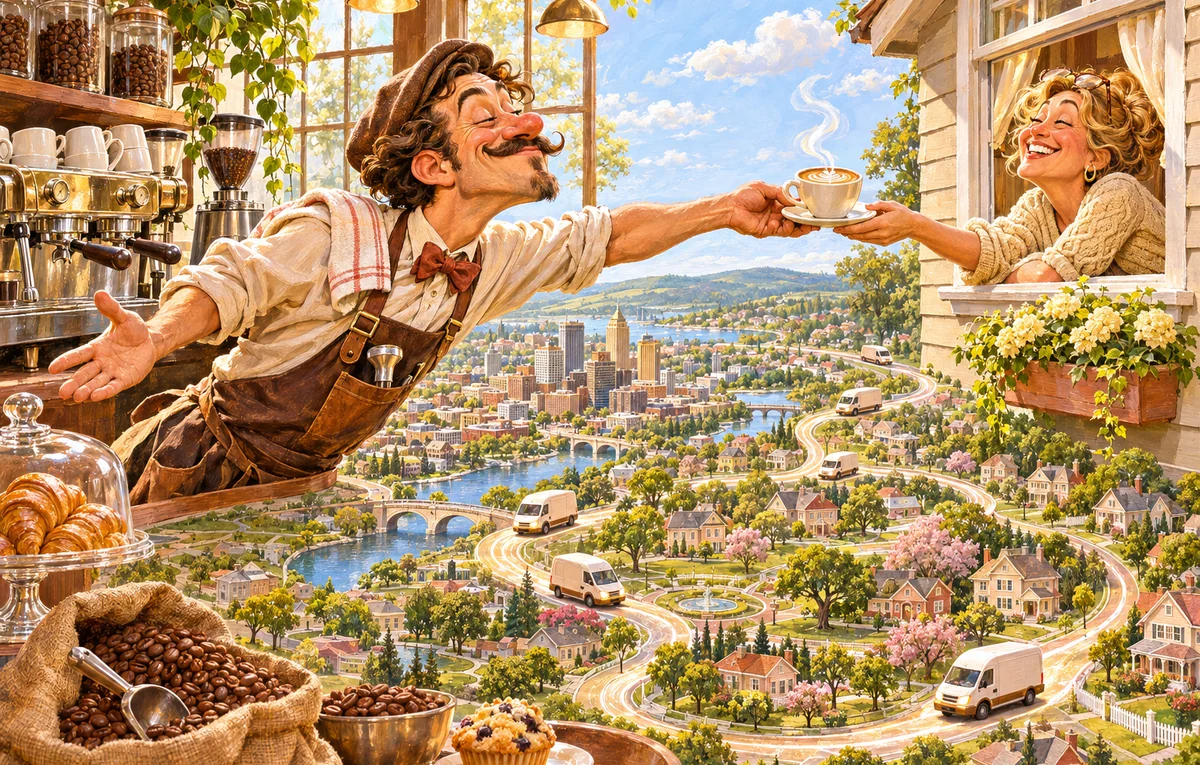
Think of how a great coffee bar works, the real geography of it. The whole art is the counter - the short, deliberate distance across which the barista hands you the cup. Everything is arranged around minimising that reach: the machine, the beans, the hand, the customer, all pulled into one tight choreography so the coffee crosses the smallest possible gap at the perfect moment. Walmart's move is an attempt to take that counter and stretch it across an entire metropolis, so the reach from shelf to doorstep feels as short as the pass from machine to palm. The city becomes the bar, and every address becomes a stool.
The insight the Compass draws from it is that convenience is really a war on distance, and distance is the most geographic thing there is. Every leap in how we get our goods has been a shortening of a gap - the market to the corner shop, the shop to the supermarket, the supermarket to the screen. This is the next shortening, and like the others it does not merely change shopping. It changes the meaning of where you live, because when the counter can reach any doorstep equally, the old advantage of being near the store quietly evaporates. Proximity stops being a privilege when everywhere is proximate.
That is the quiet power in the phrase new standard across the US, and it is worth taking seriously rather than as marketing. Standards reshape expectation, and expectation reshapes place. Once a city learns that the counter comes to it, the trip to the store starts to feel like an imposition rather than a routine, and the geography people tolerated for a century starts to feel like friction nobody signed up for. The bar that reaches you redraws the map of what near even means. Los Angeles is the test. The redrawing is the product.
So watch LA, then St Louis, then Miami, because what is being piloted is not a delivery service so much as a new definition of distance, rolled out one hard city at a time. If the counter really can stretch across the sprawl, the places built around the drive to the store will wake up to find the store already standing at the door. The barista used to wait behind the bar for the city to arrive. Now the bar is learning to walk the city - cup in hand, straight to the window.