Never Order the Same Cup Twice
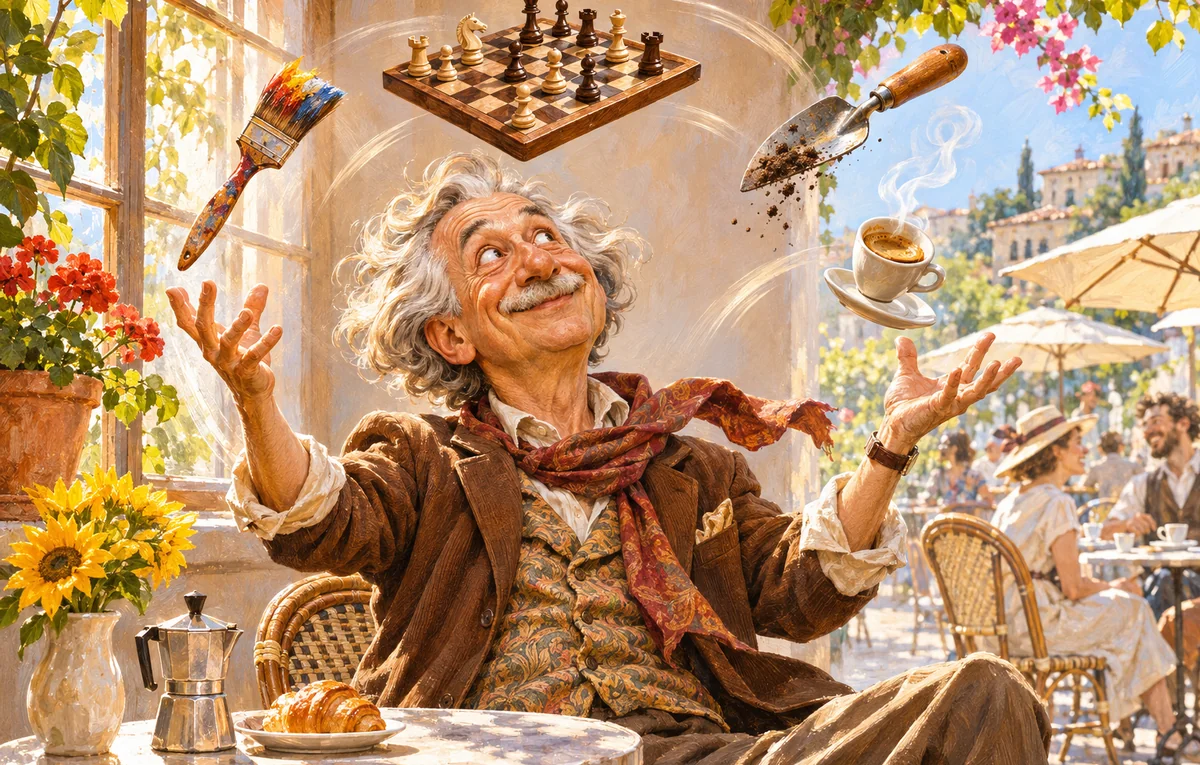
Everyone chasing the one perfect brain hack has been looking for the wrong number of answers. A decade-long study of 4,253 older Chinese adults went hunting for the single protective hobby - the crossword, the walk, the instrument that would hold the mind together - and found instead that no single pursuit carried the win. It was variety that did it. People who kept several different activities running were tied to 45 percent lower odds of cognitive decline, according to Tech Times. Not the hobby. The spread of hobbies. The menu, not the dish.
This cuts against almost everything self-improvement culture sells, which is relentlessly monogamous. Pick your thing. Go deep. Ten thousand hours. Master one craft and let it define you. The research politely declines the premise. The brain, it turns out, is not rewarded for devotion to a single groove; it is rewarded for being dragged into unfamiliar rooms often enough that it never quite settles. Depth is a lovely story. Breadth is what kept the wiring lit.
Think of the regular who has ordered the exact same flat white, same size, same stool, every morning for fifteen years. There is a dignity to it, and there is also a kind of sleep. The hand knows the shape of the cup before it arrives. Nothing is being asked of anyone. Compare that to the person who treats the counter as an experiment - single-origin on Monday, a rough French press on Wednesday, something cold and strange on Friday, a bitter little cup from a country they cannot place by the weekend. The second person is not more serious about coffee. They are keeping their palate awake. Every unfamiliar cup is a small demand on attention, and attention, used, does not fade as fast.
That is the mechanism hiding under the statistic. A new hobby is cognitively expensive in the best way. It forces the brain to build rather than retrieve, to hold instructions it does not yet have reflexes for, to fail a little and adjust. The second hobby taxes different circuits than the first, the third different again, and the sheer act of switching between them is its own workout - a mental gear change that a single lifelong pursuit, however beloved, stops providing once the moves go automatic. Mastery is the enemy here, quietly. The moment a thing becomes effortless it stops paying the dividend that made it worth starting.
The behaviour this rewards is almost embarrassingly easy to adopt and almost impossible for most people to actually do, because it violates the instinct to be good at something. Being a beginner is uncomfortable. It is slow and clumsy and faintly humiliating, and the tidy appeal of sticking to your one competent thing is that you never have to feel the drop. But the drop is the point. The awkwardness of the second week of anything is the tax receipt for a mind that will still work in thirty years. Comfort, in this reading, is not neutral. It is a slow sedative with a pleasant aftertaste.
So the usable instruction is not find your passion, which has launched a thousand paralysed afternoons. It is collect a few, keep them in rotation, and let yourself be mediocre at all of them. The crossword alone will not save anyone. Neither will the garden, or the chess, or the painting you keep meaning to resume. The portfolio saves you. Diversify the mind the way a sensible person diversifies anything they cannot afford to lose. The barista who learns your order by heart is being kind. The brain, meanwhile, would quietly prefer you kept it guessing.